
EDAC HCl
ABOUT EDAC
1-(3-Dimethylaminopropyl)-3-ethylcarbodiimide hydrochloride, EDAC (CAS 25952-53-8) is commonly known as water-soluble carbodiimide (WSC) and is used as a versatile coupling agent to form amide, ester or thioester bond and thus to cross-link proteins, nucleic acids or to bind molecules to surfaces in aqueous or organic media. There are also examples in which WSC is used as water scavenger or as a reagent for heterocyclic ring formation. Water-soluble carbodiimide exists in different forms as the free base, methiodide or its hydrochloride salt. The HCl salt is the most convenient form due to its long term storage stability and is only slightly sensitive to hydrolysis.
EDAC VARIATIONS
Kemilab offers all three EDAC varieties.
1-(3-Dimethylamino)propyl-3-ethylcarbodiimide hydrochloride
CAS 25952-53-8
Synonyms:
Water soluble carbodiimide (WSC)
EDAC.HCl
EDC
EDC.HCl
1-(3-Dimethylamino)propyl-3-ethylcarbodiimide
CAS 1892-57-5
Synonyms:
EDC
EDC free base
EDAC free base
1-(3-Dimethylamino)propyl-3-ethylcarbodiimide. methiodide
CAS 22572-40-3
Synonyms:
EDC.Mel
EDAC.Mel
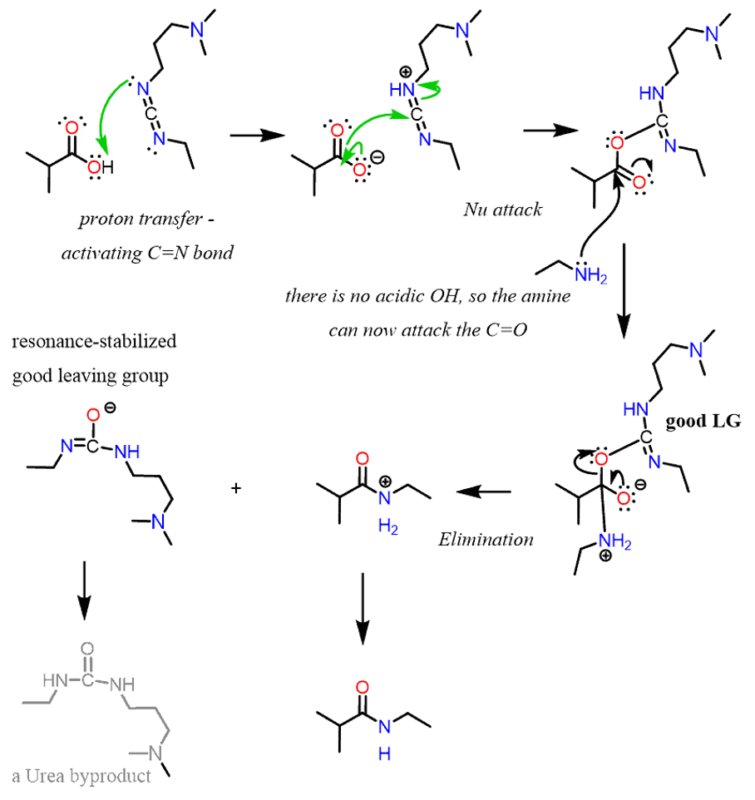
Serve as an example mechanism of coupling reaction of carboxylic acid with an amine using EDAC.HCl as coupling agent.
First an O-acylisourea intermediate is formed by the reaction of a carboxylic acid and the carbodiimide. The O-acylisourea is a highly reactive species that readily reacts with amines, peptide coupling additives or reducing agents. EDAC.HCl is transformed to the corresponding urea during coupling reactions, which has the advantage over DCU or DIC that it can removed from the reaction mixture by extraction or be washed out from solid phase synthesis applications. However, the O-acylisourea can rearrange irreversibly to an N-acylurea and also racemise the α-carbon of the amino acid via formation of an oxazol-4(5H)-one [azlactone]. N-Acylurea formation and racemisation may be reduced by using intermediate nucleophiles, which convert the O-acylurea to an activated ester containing the nucleophile.
EDAC coupling (without nucleophil additive) is illustrated in the figure below taken over from the literature.